Model Providers
A model provider is the user-facing execution target in CodeAlta: it owns credentials, endpoint settings, model discovery, the selected model, reasoning effort, and optional context/compaction metadata.
The preferred workflow is the Model Providers dialog (Ctrl+G Ctrl+R). Advanced users can edit the same TOML file directly at ~/.alta/config.toml.
Use Test before saving provider changes. It catches missing credentials, unsupported models, endpoint mistakes, and login-flow issues before the provider becomes the active execution target.
Default configuration file
On first run, CodeAlta creates a default ~/.alta/config.toml with common providers disabled. Later launches leave your existing global config untouched, even when a newer CodeAlta version bundles additional default entries, so you can remove, rename, or customize providers without startup adding them back. Enable only the providers you want to use.
| Provider key | Display name | Type | Default model or role | Credential field |
|---|---|---|---|---|
alibaba |
Alibaba | openai-chat |
qwen3.7-max |
CODEALTA_ALIBABA_API_KEY |
anthropic |
Anthropic | anthropic |
claude-sonnet-4-6 |
CODEALTA_ANTHROPIC_API_KEY |
azure-openai |
Azure OpenAI | azure-openai |
Azure deployment name | CODEALTA_AZURE_OPENAI_API_KEY |
codex |
Codex | codex |
gpt-5.5, high reasoning |
ChatGPT/Codex OAuth state |
copilot |
Copilot | copilot |
claude-sonnet-4.6, high reasoning |
GitHub device flow by default |
deepseek |
DeepSeek | openai-chat |
deepseek-v4-pro |
CODEALTA_DEEPSEEK_API_KEY |
gemini |
Gemini | google-genai |
provider-discovered | CODEALTA_GEMINI_API_KEY |
kimi-for-coding |
Kimi for Coding | anthropic compatible |
K2P6, high reasoning |
CODEALTA_KIMI_API_KEY |
minimax |
MiniMax | anthropic compatible |
MiniMax-M2.7, low reasoning |
CODEALTA_MINIMAX_API_KEY |
openai |
OpenAI | openai-responses |
gpt-5.5, high reasoning |
CODEALTA_OPENAI_API_KEY |
xai |
xAI Grok | xai |
grok-4.3, high reasoning |
xAI Grok OAuth state |
zai |
Z.ai | openai-chat |
glm-5.1 |
CODEALTA_ZAI_API_KEY |
A separate [chat] section chooses the default enabled provider:
[chat]
default_provider = "openai"
Project-local overrides can live in <project>/.alta/config.toml. Project files currently override [chat].default_provider and each provider's selected model / reasoning_effort; global ~/.alta/config.toml still defines the provider registrations, credentials, endpoints, and advanced provider metadata.
Project-local provider preferences are useful for repository-specific defaults, but avoid committing secrets. Prefer api_key_env in the global provider definition so credentials stay in your user environment.
Provider dialog
Open the dialog with Ctrl+G Ctrl+R, /model_providers, or the provider summary in the footer. Use Refresh (or /model_providers_refresh) to reload the saved configuration from disk and retest provider availability, for example after starting a local LLM server that was offline earlier.
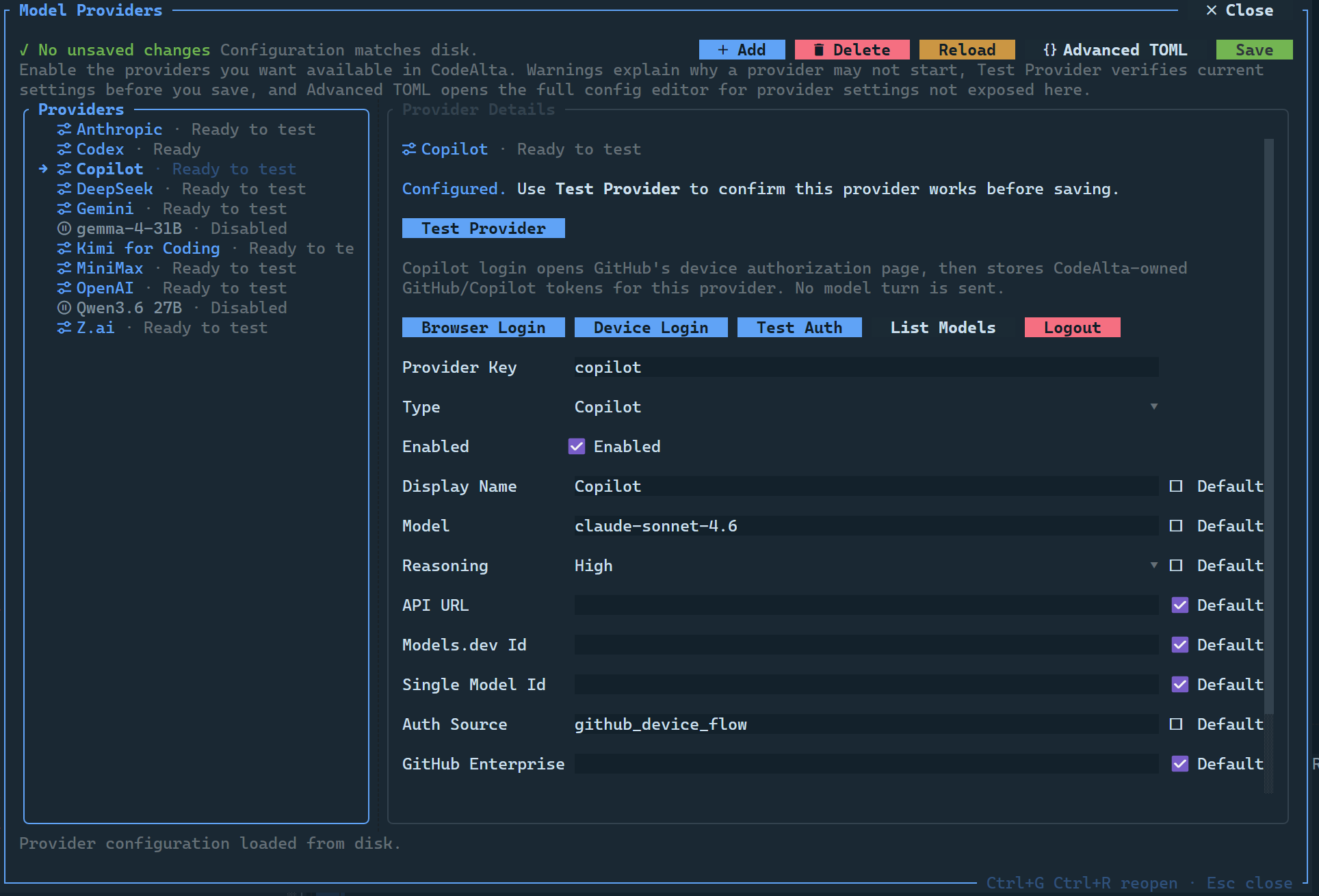
The dialog can:
- add, delete, enable, and disable provider entries;
- validate provider keys, endpoint URLs, required credentials, and conflicting settings;
- store an API key directly or refer to an environment variable;
- list and choose a provider model on demand when the Model field is not using its default;
- run provider tests before applying changes; a successful test automatically enables that provider;
- start and monitor Codex/Copilot browser or device login flows; successful login automatically enables that provider;
- refresh saved providers from disk and retest runtime availability without reopening the app;
- preserve advanced TOML settings such as
profile,compaction,extra_body,model_overrides, andprotocol_trace; - open an Advanced TOML editor with live validation.
Advanced TOML reference
Global provider entries live under [providers.<provider-key>]. Provider keys are normalized to lower case; codex and copilot also receive their default provider type when type is omitted. Supported canonical provider types are codex, copilot, xai, openai-chat, openai-responses, azure-openai, anthropic, google-genai, and vertex-ai.
Common provider fields are:
| Field | Purpose |
|---|---|
enabled |
Enables or disables the provider entry. Missing means enabled after normalization. |
display_name |
Label shown in provider selectors and dialogs. |
type |
Provider type. Common aliases such as openai, responses, aoai, gemini, vertex, and github-copilot are normalized to the canonical types above. |
model |
Default model id for this provider. |
reasoning_effort |
Default reasoning effort: none, minimal, low, medium, high, xhigh, or max. Providers advertise the values supported per model. |
api_key / api_key_env |
Literal API key or environment variable name for API-key providers. Prefer api_key_env. |
api_url |
Absolute endpoint override. Azure OpenAI, Codex, and Copilot require HTTPS except localhost test transports. |
network_timeout_seconds |
Positive OpenAI/Azure SDK network timeout override for openai-chat, openai-responses, azure-openai, and codex. Leave unset for the OpenAI SDK default timeout of 100 seconds. |
protocol_trace |
Enables low-level protocol tracing for OpenAI, Codex, and Copilot transports. |
models_dev_provider_id |
Optional models.dev provider id used to enrich model metadata where supported. |
single_model_id |
Fixed model id for endpoints that do not expose a model list. |
models_include_regex |
Optional .NET regular expression applied to model ids after discovery/fallback. When unset, all discovered models remain visible; examples include model1|model2 or model\d+. |
sort_models |
Set to true to sort discovered models alphabetically by display name (then id) in selectors. Defaults to false, preserving provider-returned order. |
profile |
Compatibility profile block; see below. |
compaction |
Local raw-API compaction settings; see Context usage and compaction. |
model_overrides |
Per-model metadata overrides; see Model metadata overrides. |
extra_body |
Additional OpenAI-compatible request-body TOML fields; only used by openai-chat and openai-responses. |
request |
Request-level headers and OpenAI-compatible body defaults; see Request customizations. |
model_request |
Per-model request overrides for OpenAI-compatible providers; see Model request overrides. |
Provider-type-specific fields and restrictions:
| Type | Credential and endpoint fields | Additional fields handled for that type |
|---|---|---|
openai-chat, openai-responses |
api_key or api_key_env; optional api_url, organization_id, project_id |
network_timeout_seconds, models_dev_provider_id, single_model_id, models_include_regex, extra_body, request, model_request, profile, compaction, model_overrides, protocol_trace |
azure-openai |
api_key or api_key_env; required Azure OpenAI resource api_url |
network_timeout_seconds, models_dev_provider_id, single_model_id, models_include_regex, profile, compaction, model_overrides, protocol_trace |
anthropic |
api_key or api_key_env; optional api_url |
models_dev_provider_id, single_model_id, models_include_regex, request.headers, request.remove_headers, profile, compaction, model_overrides |
google-genai |
api_key or api_key_env; optional api_url |
models_dev_provider_id, single_model_id, models_include_regex, request.headers, request.remove_headers, profile, compaction, model_overrides |
vertex-ai |
project and location are required when enabled; optional api_url |
models_dev_provider_id, single_model_id, models_include_regex, request.headers, request.remove_headers, profile, compaction, model_overrides |
mistral |
api_key or api_key_env; optional api_url |
models_dev_provider_id, single_model_id, models_include_regex, request.headers, request.remove_headers, profile, compaction, model_overrides |
codex |
ChatGPT/Codex OAuth state; no api_key or api_key_env; optional api_url |
network_timeout_seconds, models_include_regex, auth_source, account_id, max_concurrent_requests, text_verbosity, include_encrypted_reasoning, model_discovery, response_transport, send_responses_beta_header, send_installation_id, installation_id_source, experimental, profile, compaction, protocol_trace |
copilot |
GitHub device flow by default; optional api_url |
auth_source, github_enterprise_url, github_token_env, copilot_token_env, model_discovery, enable_model_policies, include_preview_models, experimental, single_model_id, models_include_regex, models_dev_provider_id, profile, compaction, model_overrides, protocol_trace |
xai |
xAI Grok OAuth (browser PKCE or device flow); optional api_url |
auth_source, model_discovery, single_model_id, models_include_regex, models_dev_provider_id, request, model_request, profile, compaction, model_overrides, protocol_trace |
For a recognized reasoning model through openai-responses against the official OpenAI endpoint, CodeAlta requests summary: auto and encrypted reasoning content even when effort is left to the service's model-specific default. The summary feeds the visible reasoning timeline, while the opaque encrypted item preserves stateless reasoning continuity between locally replayed calls. OpenAI-compatible custom endpoints retain their existing summary and encrypted-content request shape. Local replay preserves the relative order of assistant messages, opaque reasoning items, and tool calls.
Codex accepts these values for constrained fields: auth_source = "codealta_oauth", "codex_auth_import", "codex_auth_file_readonly", or "external_token_command"; text_verbosity = "low", "medium", or "high"; model_discovery = "codex_endpoint_with_static_fallback" (default), "codex_endpoint", or "static"; response_transport = "websocket_with_http_fallback" or "http"; and installation_id_source = "codealta_state", "codex_home_import", or "codex_home_readonly".
Codex subscription transport is isolated from ordinary OpenAI-compatible Responses providers. The default uses WebSocket with bounded safe retry and HTTP fallback; response_transport = "http" forces the Codex HTTP/SSE adapter. The legacy programmatic "sse" alias remains runtime-tolerated but is not a valid config value. Both transports preserve configured endpoint query parameters and send session-id, thread-id, and x-client-request-id; HTTP sends Accept: text/event-stream. send_responses_beta_header defaults to false and is an opt-in compatibility switch for turn requests only—model discovery never sends that beta header.
The Codex HTTP adapter uses the configured HTTP transport and combines SSE framing with SDK deserialization of standard response.* events. Codex streams stop at the first terminal event, reject premature EOF, retain indexed completed output items, and continue inference for explicit end_turn: false. Reasoning summary part/done and sequential-cutoff event forms are understood, although sequential-cutoff delivery is not requested by default. Models marked for Responses Lite (including the bundled GPT-5.6 Sol/Terra/Luna entries) receive Lite-specific developer input items and omit top-level tools/instructions; non-Lite request shapes are unchanged. With no session effort override, CodeAlta applies the model's advertised default and requests summary: auto, allowing the service to select its most detailed supported summarizer so provider summary events appear in the reasoning timeline; explicit None disables summary delivery. Terminal raw-reasoning extension data is not relabeled as a visible summary.
Subscription model discovery uses a five-second outer timeout and up to three attempts for network, timeout, and HTTP 5xx failures, while 4xx responses—including 401—are not retried. Successful ETags are retained in model metadata, and codex_endpoint_with_static_fallback falls back to the bundled catalog after an eligible discovery failure. Initial/event metadata is allowlisted: rate limits and credits feed usage, model reroutes and safety/verification/moderation produce transient updates, and persisted provider state contains only bounded request/model/ETag/reasoning/rate-limit summaries. Raw headers, moderation payloads, turn state, credentials, and unknown metadata are not persisted.
Copilot accepts auth_source = "github_device_flow", "github_token_env", or "copilot_token_env"; model_discovery = "copilot_endpoint_with_static_fallback", "copilot_endpoint", or "static". github_token_env is required when using GitHub-token auth, and copilot_token_env is required when using Copilot-token auth.
xAI Grok accepts auth_source = "xai_browser_oauth" or "xai_device_flow"; model_discovery = "xai_endpoint_with_static_fallback", "xai_endpoint", or "static". Both auth sources store CodeAlta-owned access and refresh tokens through the public Grok-CLI OAuth client and unlock SuperGrok / Grok Heavy plan access on accounts that have subscribed.
Compatibility profile
Use [providers.<provider-key>.profile] only when a provider-compatible endpoint needs behavior different from CodeAlta's default transport profile. The supported profile fields are:
| Field | Meaning |
|---|---|
supports_developer_role |
Whether requests may use a developer-role message. |
supports_store |
Whether the transport may use provider store/session flags where supported. |
supports_reasoning_effort |
Whether reasoning_effort can be sent to the provider. |
streams_usage |
Whether streamed responses include usage data. |
supports_thought_signatures |
Whether provider thought-signature continuity is supported. |
requires_tool_result_name |
Whether tool-result messages must include a tool name. |
requires_assistant_after_tool_result |
Whether a synthetic assistant turn must be inserted after tool results. |
supports_cache_control |
Whether cache-control metadata is supported. |
supports_strict_tools |
Whether strict tool schemas are supported. |
thinking_format |
Provider-specific thinking/reasoning format name. |
max_tokens_field_name |
Request-body field used for maximum output tokens, such as max_output_tokens or max_completion_tokens. |
reasoning_field_names |
Response fields inspected for reasoning content. |
reasoning_input_field_name |
Assistant-message field used when replaying prior reasoning content. |
supports_parallel_tool_calls |
Whether to send the Chat Completions parallel_tool_calls control when tools are available. |
The bundled Alibaba/DashScope and DeepSeek profiles are examples of verified compatibility overrides:
[providers.alibaba.profile]
supports_developer_role = false
supports_store = false
supports_reasoning_effort = false
max_tokens_field_name = "max_tokens"

[providers.alibaba.request.extra_body]
enable_thinking = true
preserve_thinking = true

[providers.deepseek.profile]
supports_developer_role = false
supports_store = false
max_tokens_field_name = "max_tokens"
reasoning_input_field_name = "reasoning_content"

[providers.deepseek.request.extra_body.thinking]
type = "enabled"
Single-model endpoints
Use single_model_id when a provider-compatible endpoint serves one model or cannot list models. The bundled MiniMax entry uses this pattern:
[providers.minimax]
single_model_id = "MiniMax-M2.7"
Request customizations
Use [providers.<provider-key>.request] for static request headers and OpenAI-compatible request-body fields. Existing top-level [providers.<provider-key>.extra_body] remains supported and takes precedence over [providers.<provider-key>.request.extra_body] for backward compatibility.
Merge order is predictable:
- generic transport behavior in code;
- bundled provider defaults from CodeAlta's copied provider-defaults content file;
- user
request.remove_headers/request.remove_extra_bodyremovals for inherited defaults; - user
request.headersandrequest.extra_body; - existing top-level
extra_bodyfor OpenAI-compatible providers; - provider-owned authentication headers, which cannot be removed or replaced by request config.
Header names such as Authorization, api-key, and x-api-key are reserved for provider authentication. Protocol traces redact common secret-bearing header names (Authorization, *-key, *token*, *secret*, and related names).
[providers.openrouter]
type = "openai-responses"
api_key_env = "CODEALTA_OPENROUTER_API_KEY"
api_url = "https://openrouter.ai/api/v1"

[providers.openrouter.request.headers]
HTTP-Referer = "https://codealta.dev"
X-Title = "CodeAlta"

[providers.openrouter.request.extra_body]
include_usage = true

[providers.openrouter.request]
remove_headers = ["X-Unwanted-Default"]
remove_extra_body = ["unsupported_default"]
Alibaba/DashScope-style OpenAI-compatible endpoints can use request body defaults without replacing older extra_body configs:
[providers.alibaba]
type = "openai-chat"
api_key_env = "CODEALTA_ALIBABA_API_KEY"
api_url = "https://dashscope-intl.aliyuncs.com/compatible-mode/v1"

[providers.alibaba.request.extra_body]
enable_search = false
Alibaba/DashScope, MiniMax, and DeepSeek compatibility defaults are bundled in CodeAlta's provider-defaults content file. You usually do not need to restate them in config.toml; explicit profile, request, and extra_body values still win when you do. The Alibaba defaults request streaming usage with stream_options = { include_usage = true } and enable Alibaba thinking plus thinking replay with enable_thinking = true and preserve_thinking = true for the Chat Completions transport.
DeepSeek defaults also avoid the non-standard developer role and store parameter, use max_tokens, send DeepSeek's documented thinking = { type = "enabled" } request control by default, and preserve reasoning_content on replayed assistant messages; reasoning_effort remains available where supported.
Model request overrides
Use [providers.<provider-key>.model_request.<model-id>] to apply request mutations only when a matching model is selected. This is separate from model_overrides, which changes only metadata used by selectors and token budgeting. Matching uses the same exact/normalized/date-suffix model-id behavior as metadata overrides.
[providers.openai.model_request."gpt-5.5"]
remove_extra_body = ["reasoning_split"]

[providers.openai.model_request."gpt-5.5".extra_body]
reasoning = { effort = "high" }

[providers.openai.model_request."gpt-5.5".headers]
X-Model-Mode = "high-reasoning"
Model metadata overrides
Use [providers.<provider-key>.model_overrides.<model-id>] to correct model metadata used by the model browser, selectors, usage denominator, and compaction budget when discovery or models.dev metadata is missing or incomplete.
| Field | Effect |
|---|---|
display_name |
Overrides the model label. |
description |
Overrides the model description. |
context_window |
Total context-window tokens. Also writes contextWindow / contextWindowTokens capabilities. |
input_token_limit |
Maximum input tokens. Also writes inputTokenLimit / maxInputTokens capabilities. |
output_token_limit |
Maximum output tokens. Also writes outputTokenLimit. |
max_tokens |
Maximum output token field used as maxTokens; defaults to output_token_limit when omitted. |
supports_reasoning |
Overrides reasoning capability. |
supports_tool_call |
Overrides tool-call capability. |
supports_attachments |
Overrides attachment/image capability. |
supports_structured_output |
Overrides structured-output capability. |
For a model id that contains dots, slashes, or other TOML punctuation, quote the key:
[providers.openai.model_overrides."your-model-id"]
context_window = 200000
input_token_limit = 180000
output_token_limit = 20000
supports_reasoning = true
supports_tool_call = true
Popular providers
OpenAI platform
Use the Responses API provider for current OpenAI platform models:
[providers.openai]
enabled = true
display_name = "OpenAI"
type = "openai-responses"
model = "gpt-5.5"
reasoning_effort = "high"
api_key_env = "CODEALTA_OPENAI_API_KEY"
api_url = "https://api.openai.com/v1"
Use openai-chat for OpenAI-compatible Chat Completions endpoints.
Alibaba Cloud Model Studio
Alibaba Cloud Model Studio exposes an OpenAI-compatible Chat API that works with CodeAlta's openai-chat provider type:
[providers.alibaba]
enabled = true
display_name = "Alibaba"
type = "openai-chat"
model = "qwen3.7-max"
api_key_env = "CODEALTA_ALIBABA_API_KEY"
api_url = "https://dashscope-intl.aliyuncs.com/compatible-mode/v1"
CodeAlta's bundled Alibaba/DashScope defaults follow the OpenAI Chat API documentation: system messages are used instead of developer messages, store is not sent, maximum output tokens use max_tokens, OpenAI-style reasoning_effort is not sent, streaming requests ask for the final usage chunk with stream_options.include_usage = true, and Alibaba's non-standard enable_thinking = true and preserve_thinking = true controls are sent through extra_body by default. Override either value under request.extra_body, legacy extra_body, or a model-specific model_request entry, or list it in request.remove_extra_body when an endpoint rejects it. Other Alibaba-specific parameters such as thinking_budget, top_k, enable_search, and search_options remain opt-in via request.extra_body or extra_body because their support varies by model and mode. CodeAlta keeps the OpenAI-compatible Chat default of sending parallel_tool_calls when tools are available; set profile.supports_parallel_tool_calls = false only for endpoints or models that reject that parameter.
Azure OpenAI
Use azure-openai for Azure OpenAI resource endpoints. The Azure OpenAI SDK uses deployment names where OpenAI APIs use model ids, so set model and/or single_model_id to your deployment name:
[providers.azure-openai]
enabled = true
display_name = "Azure OpenAI"
type = "azure-openai"
model = "my-gpt-4o-mini-deployment"
api_key_env = "CODEALTA_AZURE_OPENAI_API_KEY"
api_url = "https://your-resource.openai.azure.com"
network_timeout_seconds = 180
Use network_timeout_seconds when long Azure OpenAI or OpenAI-compatible streaming requests otherwise fail with the SDK's default network timeout.
Azure OpenAI does not expose model listing through the SDK used by CodeAlta. If single_model_id is not set, CodeAlta uses model as the single deployment shown in model selectors.
Anthropic
[providers.anthropic]
enabled = true
display_name = "Anthropic"
type = "anthropic"
model = "claude-sonnet-4-6"
api_key_env = "CODEALTA_ANTHROPIC_API_KEY"
Anthropic-compatible providers can use the same type with a custom api_url and, when needed, single_model_id.
Gemini / Google GenAI
Use google-genai for the Gemini API with an API key. Leave model unset
to choose from provider-discovered Gemini models, or set it explicitly:
[providers.gemini]
enabled = true
display_name = "Gemini"
type = "google-genai"
api_key_env = "CODEALTA_GEMINI_API_KEY"
model = "gemini-2.5-pro"
Vertex AI
Vertex uses a Google Cloud project and location instead of an API-key endpoint:
[providers.vertex]
enabled = true
display_name = "Vertex"
type = "vertex-ai"
project = "my-gcp-project"
location = "europe-west4"
models_dev_provider_id = "google"
model = "gemini-2.5-pro"
reasoning_effort = "high"
Mistral
Use mistral for the Mistral chat-completions API. CodeAlta streams turns over Mistral's /v1/chat/completions endpoint, serializes user/assistant/tool roles directly, maps streamed tool-call fragments back into CodeAlta tool calls, and uses the Mistral SDK for model listing.
[providers.mistral]
enabled = true
display_name = "Mistral"
type = "mistral"
api_key_env = "CODEALTA_MISTRAL_API_KEY"
model = "mistral-small-latest"
models_dev_provider_id = "mistral"
Codex subscription endpoint
The codex provider type is ChatGPT/Codex subscription endpoint access. It is intentionally distinct from OpenAI platform API keys.
[providers.codex]
enabled = true
display_name = "Codex"
type = "codex"
model = "gpt-5.5"
reasoning_effort = "high"
model_discovery = "codex_endpoint_with_static_fallback"
Codex credentials are stored in CodeAlta-owned state through its login flow. It does not accept api_key, api_key_env, or arbitrary extra_body.
CodeAlta follows Codex's ordered per-model reasoning-effort catalog for recognized inference values. GPT-5.6 Sol, Terra, and Luna support max as their highest inference effort in the static fallback catalog. CodeAlta does not expose Codex's ultra client tier because CodeAlta does not implement its separate proactive delegation policy. A reasoning-summary part whose body, after an optional bold heading, is exactly <!-- --> has no body while streaming, then is hidden from completed chat history with that heading. Literal comments in real prose or fenced examples and raw session data are retained.
Copilot
[providers.copilot]
enabled = true
display_name = "Copilot"
type = "copilot"
model = "claude-sonnet-4.6"
reasoning_effort = "high"
auth_source = "github_device_flow"
model_discovery = "copilot_endpoint_with_static_fallback"
For non-interactive environments, the dialog and TOML support GitHub-token or Copilot-token environment-variable modes.
xAI Grok
The xai provider type talks to the xAI API at https://api.x.ai/v1. Both auth flows persist CodeAlta-owned access and refresh tokens against the public Grok-CLI OAuth client and unlock SuperGrok / Grok Heavy plan access on accounts that have subscribed.
[providers.xai]
enabled = true
display_name = "xAI Grok"
type = "xai"
model = "grok-4.3"
reasoning_effort = "high"
auth_source = "xai_browser_oauth"
model_discovery = "xai_endpoint_with_static_fallback"
Two auth flows are supported:
xai_browser_oauth— PKCE login againstauth.x.ai; the dialog opens the consent screen and listens on the registered loopback redirect URI before persisting tokens under CodeAlta state.xai_device_flow— the same OAuth client over RFC 8628 device authorization for headless / SSH / VPS hosts.
Refresh tokens are rotated automatically by the auth manager. The bundled static catalog ships grok-4.3, grok-4, and grok-4-fast; live discovery uses xAI's /v1/language-models endpoint so image / video variants are excluded automatically.
Models, reasoning, and metadata
Provider model discovery comes from the upstream provider API when available. CodeAlta can enrich or correct model metadata with:
models_dev_provider_idto map a provider to the local models.dev catalog;model_overridesfor context windows or output limits;single_model_idfor single-model endpoints that do not expose/models;models_include_regexto keep only model ids matching one .NET regular expression, for examplegpt-5|claudeor^gemini-.*-pro.
When the models.dev provider id is inferred from the provider key, CodeAlta maps local aliases to models.dev ids where needed: copilot resolves as github-copilot, and gemini resolves as google.
Reasoning effort is selected per provider/model where supported. When a selected model does not support reasoning, CodeAlta shows the effective setting in selectors and live-tool model resolution.
Context usage and compaction
The footer context indicator uses the provider/model input-token limit. If only a total context window is known, CodeAlta treats it as the practical input limit; if both total context and output limit are known, it derives input limit as context_window - output_token_limit unless an explicit input limit is configured.
Local raw-API compaction can be tuned with an optional block:
[providers.openai.compaction]
enabled = true
ratio = 0.95
summary_output_ratio = 0.10
post_compaction_target_ratio = 0.10
summary_share_of_target = 0.40
file_context_share_of_summary_target = 0.15
keep_last_user_message = true
allow_split_turn = true
Compaction fields are validated before the configuration is saved or accepted at startup:
| Field | Default | Accepted range / meaning |
|---|---|---|
enabled |
true |
Enables automatic threshold compaction. |
ratio |
0.95 |
Active-context/input-limit ratio that triggers automatic compaction; must be > 0 and <= 1. |
summary_output_ratio |
0.10 |
Summarizer output budget as a share of the input limit; must be > 0 and <= 0.50. |
post_compaction_target_ratio |
0.10 |
Preferred active-context target after compaction; must be > 0 and <= 1. |
summary_share_of_target |
0.40 |
Share of the post-compaction target offered to summary generation; must be > 0 and <= 1. |
file_context_share_of_summary_target |
0.15 |
Share of the summary target available for model-visible file context; must be >= 0 and <= 1. |
keep_last_user_message |
true |
Keeps the latest user message as an anchor during compaction. |
allow_split_turn |
true |
Allows compaction to split a large turn while preserving continuation state. |
Most users should leave these defaults unchanged.